
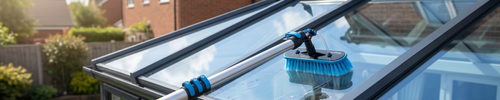
Conservatory Roof, Hard Water Stains, Fascias & Gutters: The Complete UK Cleaning Guide
, 23 min reading time
, 23 min reading time
Every spring and summer, UK homeowners search for answers to the same clutch of stubborn exterior cleaning questions. How do I safely clean my conservatory roof without climbing on it? Why do my windows have a hazy white film that won't budge? What is the easiest way to clean my gutters, fascias, and soffits without scaffolding?
The answer to all four is the same piece of kit — a water-fed telescopic pole long enough to reach your roofline. This guide covers every topic in full, with the method, the mistakes to avoid, and exactly what to look for when choosing your pole.
Conservatory roofs are one of the most neglected surfaces on a UK home — and one of the most searched-for cleaning challenges. A combination of algae, green mould, lichen, hard water deposits, and general atmospheric grime builds up steadily on both polycarbonate and glass panels, blocking light and making the space feel dark and unloved.
The single most important rule before anything else:
⚠ Never stand or walk on a conservatory roof. Whether the panels are glass or polycarbonate, they are not designed to support human weight. A fall through a conservatory roof causes serious, potentially fatal injuries. Every cleaning method in this guide is carried out from the ground using an extended pole.
What you will need
⚠ Do not use a pressure washer on a conservatory roof. High-pressure water instantly blows the hermetic seals on double-glazed glass panels, causing permanent internal condensation and leaks that are expensive to repair. It can also crack polycarbonate panels. Always use a low-pressure flow from a standard garden hose.
Step-by-step method
Step 1 — Clear loose debris first (dry). Attach the cobweb duster to the pole and sweep the roof surface to remove loose leaves, twigs, bird droppings, and spider webs. Work from the ridge downward so debris falls away from areas you have already cleared.
Step 2 — Check the gutters before wetting. Conservatory gutters are shallower than standard gutters and block easily. If they are full, the dirty water you rinse off the roof will have nowhere to go and will overflow onto your walls and patio.
Step 3 — Wet the roof surface. Connect the hose to your outdoor tap, run the water through the pole to the brush head, and wet the entire roof surface evenly. Let it soak for 2–3 minutes to soften algae and mould before brushing.
Step 4 — Brush in gentle strokes. Work methodically across the roof in overlapping horizontal passes. Apply only light pressure — the water and soft bristles do the work. Never scrub vigorously, especially on polycarbonate panels.
Step 5 — Rinse thoroughly from top to bottom. Once the entire surface has been brushed, do a full rinse starting at the ridge and working down to the gutters. Ensure all loosened algae and dirt is flushed clear of the panels.
Step 6 — Check the gutters again. If debris has washed into the gutters during cleaning, clear them out while everything is wet and easy to move.
Step 7 — Allow to air-dry. Do not wipe the panels with cloths. Let them dry naturally — on a breezy day this takes 20–30 minutes.
How often should you clean a conservatory roof?
In the UK, most conservatory roofs need a thorough clean twice a year — once in spring (March to May) to remove winter algae and the first wave of pollen, and once in autumn (October) before leaves and damp organic debris accumulate over winter. In areas with heavy tree coverage, a third summer clean is worth adding.
✅ Tip: After cleaning, check whether light transmission inside your conservatory has noticeably improved. A visibly brighter interior after cleaning confirms how much light was being blocked — and is the best motivation to keep up with regular maintenance.
Recommended for conservatory roofs: the IGADPole 9m (30ft) Water-Fed Cleaning Kit
The 9m kit gives you the reach needed to cover the full depth of a conservatory roof from ground level, including the ridge and finial at the peak. Includes water-fed soft brush, 10m hose with in-line tap, cobweb duster, microfibre duster, soap dispenser, and all adaptors. UK free shipping.
👉 Shop the IGADPole 9m Water-Fed Kit: www.igad.co.uk/products/igadpole-30ft-9m-washing-kit-water-fed-brush-soap-dispenser-and-hose-tap
Use code IGAD20 at checkout for 20% off your order.
The cleaning method is the same for both roof types, but the materials behave differently and have different vulnerabilities. Here is what to know before you start.
Scratch risk Polycarbonate scratches easily. Always use the softest brush available and minimal pressure. Glass is more scratch-resistant, but abrasive materials still damage the anti-reflective coating.
Cleaning products For polycarbonate, use plain water or a very dilute pH-neutral cleaner only. Never use solvents, bleach, or alcohol-based cleaners — they cloud and craze the surface permanently. For glass, a pH-neutral cleaner is suitable. Avoid bleach and abrasive pastes on both.
Pressure washers Never on either surface. On polycarbonate, high pressure cracks panels and blows seals. On glass, it blows hermetic seals and causes internal condensation.
Self-cleaning glass Some glass conservatory roofs use self-cleaning coatings such as Pilkington Activ. These require specific care — never use squeegees or abrasive cleaners, which strip the coating permanently. Check with your glazier before cleaning if you are unsure whether your panels are self-cleaning.
Algae build-up Algae forms faster and sticks more stubbornly to polycarbonate. It may need a longer soaking time before brushing. On glass it builds up more slowly and is generally easier to remove with water and a soft brush.
Hard water spots Both surfaces show hard water deposits, but they are particularly visible on polycarbonate. A deionised water final rinse is especially worthwhile on polycarbonate panels.
💡 Not sure which type of roof you have? Tap the panel lightly with a knuckle. Polycarbonate gives a hollow, plastic sound. Glass gives a solid, dense sound. Polycarbonate panels also typically have fluted channels visible from the edge.
If your windows have a hazy, milky, or white streaked film that refuses to come off no matter how much you clean them — you are almost certainly dealing with hard water stains. This is one of the most common and frustrating window problems for UK homeowners, particularly in the Midlands, South East, and East of England where water hardness is high.
What causes hard water stains?
Hard water contains dissolved calcium and magnesium minerals. When hard water evaporates on glass — whether from rain, an overflowing gutter, or a previous cleaning attempt — it leaves those minerals behind as a thin white deposit. Over time, layer upon layer of mineral residue builds up into a haze that ordinary cleaning simply pushes around rather than removing.
How to tell hard water stains from ordinary grime
How to remove hard water stains — step by step
Step 1 — Clean the window normally first. Remove all loose dirt and grime before tackling the mineral deposits. Trying to treat stains on a dirty window wastes product and time.
Step 2 — Apply a mild acid solution. The most effective and safest DIY treatment is white vinegar diluted 1:1 with water, applied via spray bottle. Vinegar's acidity dissolves calcium and magnesium deposits without damaging glass. For stubborn stains, use it undiluted. Alternatively, a specialist calcium and limescale remover formulated for glass works well.
Step 3 — Allow to dwell. Leave the vinegar solution on the stained area for 5–10 minutes. For heavy, long-standing deposits, up to 15–20 minutes. Do not let it dry on the glass.
Step 4 — Agitate gently. Using a soft microfibre cloth or your water-fed brush, work the solution into the stain with gentle circular motions. You should see the deposit beginning to dissolve and lift.
Step 5 — Rinse thoroughly with clean water. Remove all traces of the vinegar solution. If you have a water-fed pole, run clean water through the brush and rinse top to bottom.
Step 6 — For persistent deposits, repeat. Very heavy build-up from years of neglect may require two or three treatments. In extreme cases, a product containing oxalic acid is more powerful, though it requires gloves and care during use.
⚠ Never use: steel wool, abrasive pads, or razor blades to scrape hard water deposits from glass. These cause permanent scratches. Never use bleach-based products on window glass — they leave their own residue and can damage seals and frames.
How to prevent hard water stains returning
Once you have cleared the deposits, prevention is straightforward. The key is to ensure that every window clean ends with a vinegar solution rinse.
Also check whether overflowing or misaligned gutters are depositing hard water onto your windows every time it rains. A blocked gutter above a window is often the hidden cause of stubborn recurring staining — which brings us neatly to the next section.
💡 The IGADPole 9m water-fed kit includes a soap dispenser that can be used to apply cleaning solution through the pole, saving you from climbing to reach upper windows during treatment.
👉 Shop the IGADPole 9m Kit: www.igad.co.uk/products/igadpole-30ft-9m-washing-kit-water-fed-brush-soap-dispenser-and-hose-tap — use code IGAD20 for 20% off.
Fascias and soffits are the boards that run along the roofline of your house — the fascia is the vertical board that faces outward (and to which the gutters are attached), while the soffits are the horizontal boards underneath the overhang. Both are almost always uPVC on modern UK homes, and both have a tendency to turn grey, streaky, and algae-stained over time.
Most homeowners never clean their fascias and soffits because they seem impossibly high up. With a long telescopic pole, the job takes less than an hour on a typical semi-detached house.
Why fascias and soffits get so dirty
⚠ Do not use a pressure washer on fascias or soffits. The high-pressure jet can force water behind the boards and into your roof structure, causing damp and rot in the timbers beneath. It can also crack aged uPVC or dislodge boards from their fixings.
Step-by-step method
Step 1 — Start with a dry cobweb sweep. Use the cobweb duster on your pole to remove spider webs, loose dirt, and insect debris from soffits before introducing water. This prevents muddy streaks running down your walls and windows below.
Step 2 — Apply a uPVC cleaner or dilute all-purpose cleaner. For light grime, plain water is sufficient. For green algae or black mould staining, a mild uPVC cleaner or a solution of warm water and a small amount of washing-up liquid applied through the soap dispenser attachment works well. Never use bleach — it weakens uPVC over time.
Step 3 — Brush along the fascia length. Work horizontally along the fascia board using the water-fed brush at a comfortable angle. The angle connector on the IGADPole brush head lets you tilt it to reach the underside of soffits without straining or overextending.
Step 4 — Pay attention to the soffit underside. The horizontal soffit face is the most heavily stained surface and the hardest to reach at an angle. Tilt the brush head using the angle connector to address the underface directly.
Step 5 — Rinse top to bottom. Start at the highest point and rinse all cleaning solution downward. If needed, give the windows below a quick final rinse after completing the fascias and soffits.
How often should you clean fascias and soffits?
Once a year is sufficient for most UK homes — ideally in spring when algae growth from the damp winter months is at its most visible. Properties in heavily wooded areas or near farmland may benefit from a second clean in early autumn.
✅ Tip: Cleaning fascias and soffits at the same time as your gutters is far more efficient. Do the dry cobweb sweep first, then the gutter clear, then the wet wash of fascias and soffits, and finally rinse everything downward. One setup, one job.
Ideal for fascias, soffits and roofline cleaning: IGADPole 9m (30ft) Water-Fed Kit
The angle connector on the water-fed brush head lets you tilt the brush to address soffits, fascias, and gutters at any angle — without ladders. Lightweight aluminium pole, 10m hose, cobweb duster, soap dispenser. Everything included.
👉 www.igad.co.uk/products/igadpole-30ft-9m-washing-kit-water-fed-brush-soap-dispenser-and-hose-tap
Use code IGAD20 at checkout for 20% off.
Blocked gutters are one of the most common and most overlooked causes of serious home maintenance problems in the UK. Water that cannot flow through a blocked gutter has to go somewhere — and it typically goes over the side, running down your walls, over your windows, and in some cases into your foundations or roof structure. The result is damp, staining, and potentially expensive structural damage.
In autumn especially, UK gutters fill with fallen leaves remarkably quickly. A gutter that was clear in September can be completely blocked by November.
Signs your gutters need clearing
Two methods for clearing gutters from the ground
Method A — Wet flush (for light leaf debris and general grime): Use the water-fed brush and hose to wet the inside of the gutter and dislodge loose debris. Work from the end farthest from the downpipe toward the downpipe, flushing debris in the direction of flow. Finish by running a sustained flow of water to check the downpipe drains freely.
Method B — Mechanical clear (for heavy compacted debris): For gutters heavily packed with decomposed leaves, attach a gutter clearing tool head to dislodge and scoop out debris before flushing. The angled design allows you to work inside the gutter channel without a ladder.
💡 Always check the downpipe. After clearing the gutter, pour a bucket of water into it at the inlet end and watch the downpipe outlet at ground level. If water flows freely within a few seconds, the downpipe is clear. If not, use a drain rod or a garden hose to clear the blockage from below.
Step-by-step
Step 1 — Inspect from below first. Walk the full length of each gutter run and look for visible blockages, sagging sections, or joints that have pulled apart. Any structural issues should be repaired before cleaning.
Step 2 — Start at the far end from the downpipe. Work toward the downpipe so you are pushing debris in the direction of natural drainage flow.
Step 3 — Flush with water. Run water through the pole brush into the gutter and use the brush head to dislodge debris. Keep the water flowing to carry loosened debris toward the downpipe outlet.
Step 4 — Check the downpipe is clear. Once the gutter is clear, run a sustained flow of water and verify it exits at the base of the downpipe without backing up.
Step 5 — Rinse the fascia face. While the pole is extended and the hose is connected, take 5 minutes to wash down the outside face of the fascia boards — gutter clearing will have splashed debris onto them.
How often should gutters be cleaned?
As a minimum, once per year in late autumn (November) after the majority of leaves have fallen. Properties with overhanging trees should clear gutters twice a year — once in autumn and once in spring. Conservatory gutters, which are shallower and block more easily, should be checked every six months.
✅ Tip: After clearing and flushing your gutters, check that every section is correctly pitched toward its downpipe. A gutter that pools water rather than draining will breed algae and moss faster than a correctly angled one.
One tool covers everything: IGADPole 9m (30ft) Water-Fed Kit — £149
Reaches standard UK two and three-storey gutters safely from the ground. Lightweight aluminium construction, dual-jet water-fed brush, 10m hose with in-line tap, cobweb duster, microfibre duster, and soap dispenser — all included. UK free shipping on every order.
👉 Shop the IGADPole 9m Kit: www.igad.co.uk/products/igadpole-30ft-9m-washing-kit-water-fed-brush-soap-dispenser-and-hose-tap
👉 Browse all pole kits: www.igad.co.uk/collections/all-water-fed-brush-sets
Use code IGAD20 at checkout for 20% off your entire order.
Bungalow (gutter height 2.5–3.5m) → 5m (17ft) kit
Single-storey extension or conservatory (3–4.5m) → 5m or 7m kit
Two-storey terraced or semi-detached (5–6.5m) → 7m (24ft) kit
Two-storey detached with steep pitch (6–7.5m) → 9m (30ft) kit
Three-storey home or tall Victorian terrace (7–9m) → 9m (30ft) kit
Conservatory roof (most styles) → 9m (30ft) kit — even though the roof itself is lower, the horizontal distance from the house wall means you need the extra length to reach the ridge comfortably
For most UK homes covering all the jobs in this guide — conservatory roof, fascias, soffits, gutters, and upper windows — the IGADPole 9m water-fed kit is the single purchase that covers everything.
👉 www.igad.co.uk/products/igadpole-30ft-9m-washing-kit-water-fed-brush-soap-dispenser-and-hose-tap — use code IGAD20 for 20% off.
Can I use washing-up liquid to clean my conservatory roof? A small amount of mild washing-up liquid diluted heavily in water is fine for routine cleaning of glass and uPVC surfaces. Avoid using it on self-cleaning glass panels, where detergent residue can interfere with the photocatalytic coating. Plain water is always the safest starting point.
My hard water stains have been there for years — can they still be removed? In most cases, yes. Long-standing calcium deposits require a longer dwell time with the acidic treatment and may need two or three treatment cycles. If deposits have become deeply etched into the glass surface over many years, full removal may not be possible, but significant improvement is usually achievable.
Is it safe to clean gutters from the ground with a pole? Yes — and it is substantially safer than using a ladder. The main limitation is visibility; you cannot always see exactly what is inside the gutter from the ground. Running water through after clearing and checking the downpipe outlet confirms the job is complete.
How do I clean inside a conservatory without wetting the interior? The water-fed pole method is an exterior-only technique. For interior conservatory roof cleaning, use a dry microfibre duster on a non-water-fed extension pole, working across the panels from a step ladder placed safely on the interior floor.
Will the IGADPole 9m kit work with my existing garden hose? Yes. The kit includes a universal garden hose adaptor compatible with standard Hozelock fittings used on most UK garden taps and hoses. The 10m hose supplied is long enough to reach from most outdoor taps to the cleaning area without needing an extension.
Can one person manage a 9m pole alone? Yes — the IGADPole 9m is designed for single-person use. The aluminium construction keeps the weight manageable even at full extension. Some users find it helpful to brace the base of the pole against their hip when working at maximum height.
Ready to tackle all of it in one afternoon?
The IGADPole 9m (30ft) Water-Fed Cleaning Kit covers every job in this guide — conservatory roof, fascias, soffits, gutters, hard water rinsing, and upper windows — all from the ground. No ladders. No call-out fees. No scaffolding.
👉 Shop the IGADPole 9m Kit (£149): www.igad.co.uk/products/igadpole-30ft-9m-washing-kit-water-fed-brush-soap-dispenser-and-hose-tap
👉 Browse all water-fed pole kits: www.igad.co.uk/collections/all-water-fed-brush-sets
Use code IGAD20 at checkout for 20% off. UK free shipping on every order.